Introduction
A porcelain crown is one of the most common options patients ask about when they need a tooth restored and still want it to look natural. Maybe a tooth broke. Maybe an old filling is too large to repair again. Maybe a root-canal-treated tooth needs more protection. Or maybe a front tooth is dark, worn, misshapen, or covered by an old crown that no longer blends in.
“Porcelain crown” sounds simple, but it can mean several different things in modern dentistry. Some crowns are porcelain fused to metal. Some are all-ceramic. Some are zirconia. Some are lithium disilicate. Some are made in a dental lab, while others are designed and milled in the dental office with CAD/CAM technology.
That matters because porcelain crowns are not all the same. A crown that is beautiful for a front tooth may not be the best choice for a heavy grinder’s back molar. A very strong crown may not be the most translucent. A same-day crown may be convenient, but a lab-made crown may be preferred for certain high-esthetic cases. A “metal-free” crown may sound appealing, but that does not automatically make it the best option for every patient.
This article focuses specifically on porcelain and porcelain-type crowns. For a broader explanation of what dental crowns are, why crowns are used, and how crown treatment works in general, see Dental Crowns.
Here, we will focus on what patients usually mean by “porcelain crown,” the different types of tooth-colored crown materials, when porcelain crowns are used, how they compare with veneers, onlays, zirconia, metal crowns, and dental implants, what the procedure involves, how long they may last, and what to ask before choosing a material.
This article is for patient education only. It cannot determine whether your tooth needs a porcelain crown or which crown material is best for you. That decision depends on a dental exam, X-rays when needed, bite evaluation, gum health, tooth structure, symptoms, esthetic goals, medical history, and your dentist’s clinical judgment.
What Is a Porcelain Crown?
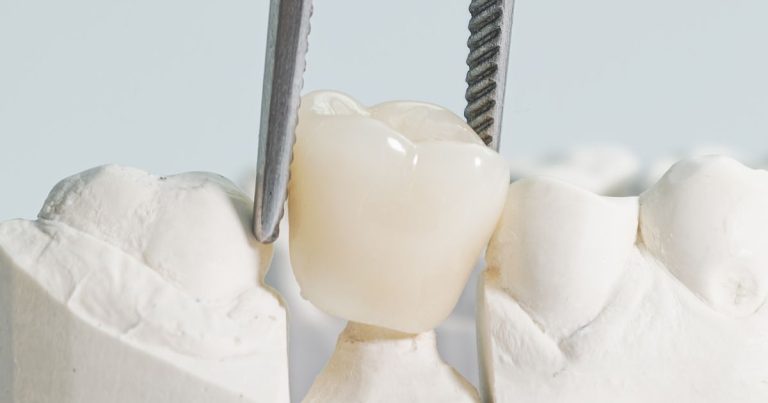
A porcelain crown is a tooth-shaped restoration that covers and protects a damaged or weakened tooth while also giving it a tooth-colored appearance.
A crown is sometimes called a “cap.” It covers the visible portion of the tooth above the gumline after the tooth has been prepared. The crown restores the tooth’s shape, chewing surface, strength, and appearance.
The word “porcelain” is where things get more complicated. Patients often use “porcelain crown” to mean any white or tooth-colored crown. Dentists may use more specific terms, such as:
- Porcelain-fused-to-metal crown
- All-ceramic crown
- All-porcelain crown
- Zirconia crown
- Lithium disilicate crown
- Feldspathic porcelain crown
- CAD/CAM ceramic crown
Each material has different strengths, esthetic qualities, thickness requirements, and clinical uses.
A useful way to think about it is this:
“Porcelain crown” is the patient-friendly term.
“Ceramic crown material” is the more technical dental conversation.
Is a Porcelain Crown the Same as a Ceramic Crown?
Sometimes, but not always.
In everyday dental conversations, “porcelain” and “ceramic” are often used loosely to describe tooth-colored crown materials. In more technical terms, porcelain is one type of ceramic, and modern ceramic crowns include several material families.
Some ceramic crowns are designed for maximum beauty and translucency. Others are designed for strength. Some are layered for esthetics. Others are milled as a single solid piece for durability.
This is why asking “Should I get a porcelain crown?” is really the beginning of the conversation, not the end of it. The better question is:
Which type of porcelain or ceramic crown makes sense for this tooth?
Porcelain Crown vs All-Ceramic Crown
An all-ceramic crown is made entirely from ceramic material. It does not have a metal substructure.
Patients often choose all-ceramic crowns because they can look very natural, especially on visible teeth. Some patients also prefer them because they are metal-free.
However, all-ceramic crowns are not all identical. Zirconia, lithium disilicate, and feldspathic porcelain each behave differently.
Porcelain-Fused-to-Metal Crown
A porcelain-fused-to-metal crown, often called a PFM crown, has a metal base with porcelain layered over it. The metal provides support. The porcelain provides tooth color.
PFM crowns have a long history in dentistry and can still be useful in selected cases. They may be recommended when the dentist wants a balance of strength and tooth-colored appearance.
Possible advantages include:
- Long clinical history
- Strength from the metal substructure
- Tooth-colored outer surface
- Useful in many restorative situations
- Possible downsides include:
- A dark line may show near the gumline in some cases
- The porcelain layer can chip
- The crown may look less translucent than some all-ceramic crowns
- More tooth reduction may be needed in some cases
- Not metal-free
Are Zirconia Crowns Porcelain Crowns?
Many patients call zirconia crowns “porcelain crowns” because they are tooth-colored and ceramic. Technically, zirconia is a ceramic material, but it is not the same as traditional porcelain.
Zirconia is often chosen when strength is a major concern. It may be used for molars, patients with stronger bite forces, or situations where durability matters. Newer zirconia materials can also be more esthetic than older versions, but zirconia still varies by type.
Some zirconia crowns are monolithic, meaning they are made from one solid piece of zirconia. Others are layered with porcelain for improved appearance.
What Is a Lithium Disilicate Crown?
Lithium disilicate is a glass-ceramic crown material often used when esthetics are important. It can be strong enough for many selected crown cases while offering a more natural-looking appearance than some older ceramic options.
Many patients know lithium disilicate by brand names, but brand-specific claims should be discussed with a dentist. The key point is that lithium disilicate is commonly part of the modern “porcelain crown” conversation, especially for visible teeth.
What Is Feldspathic Porcelain?
Feldspathic porcelain is a traditional, highly esthetic porcelain material. It can create beautiful translucency and lifelike effects, especially in cosmetic dentistry.
However, it is not always the strongest choice for high-bite-force situations. It may be more commonly discussed in veneers, layered ceramics, and highly esthetic anterior work than as the universal choice for every crown.
Why Porcelain Crowns Matter
Porcelain crowns matter because they can restore a damaged tooth while preserving a natural-looking smile.
A tooth may need more than a filling when it has lost too much structure or is at risk of breaking. A porcelain crown can cover the tooth, restore chewing shape, improve appearance, and help protect the remaining tooth structure.
Porcelain-type crowns are especially important for visible teeth. Patients often want a crown that blends with surrounding teeth, reflects light naturally, and does not show metal near the gumline.
A porcelain crown may help with:
- A broken tooth
- A cracked tooth
- A large cavity
- A tooth with a very large old filling
- A tooth after root canal treatment
- A severely discolored tooth
- A worn-down tooth
- A misshapen tooth
- An old crown that looks unnatural
- A tooth that needs both strength and cosmetic improvement
The main advantage of porcelain-type crowns is that they can combine restoration and esthetics. The main challenge is choosing the right material and design for the tooth.
Who Might Need a Porcelain Crown?
A porcelain crown may be considered when a tooth needs full-coverage protection and the patient wants a tooth-colored result.
Common situations include:
- A front tooth that needs a crown but must look natural
- A premolar or molar with a large cavity or broken cusp
- A root-canal-treated tooth that needs protection
- A cracked tooth that can still be saved
- A tooth with an old, failing crown
- A tooth with severe discoloration and structural weakness
- A tooth worn down by grinding or erosion
- A tooth that needs to match veneers or other cosmetic work
- A patient who prefers a metal-free restoration when clinically appropriate
The important phrase is “when clinically appropriate.” A porcelain crown is not selected based only on appearance. The dentist must consider the tooth, bite, gum health, remaining structure, and material limitations.
Are Porcelain Crowns Good for Front Teeth?
Porcelain-type crowns are often a strong option for front teeth because esthetics are so important in the smile zone.
Front-tooth crowns may require special attention to:
- Shade
- Translucency
- Tooth shape
- Surface texture
- Gumline symmetry
- Smile line
- How light passes through the crown
- How the crown matches neighboring teeth
- Whether the underlying tooth is dark
- Whether only one front tooth is being crowned
Matching one front crown to natural neighboring teeth can be one of the hardest esthetic tasks in dentistry. The dentist may recommend a particular ceramic material, lab-made crown, custom shade appointment, or additional cosmetic planning depending on the case.
Are Porcelain Crowns Strong Enough for Molars?
Sometimes, yes.
Modern ceramic materials, especially zirconia and some stronger glass-ceramics in selected cases, can be used for back teeth. However, molars handle heavy chewing forces, so material selection matters.
A porcelain-type crown on a molar may need to account for:
- Bite force
- Grinding or clenching
- Available space for crown thickness
- Opposing tooth material
- Whether the tooth has had a root canal
- How much tooth structure remains
- Crown height and retention
- Whether the patient chews ice or hard objects
A dentist may recommend zirconia, PFM, metal, or another material depending on the case. A highly esthetic porcelain that works beautifully on a front tooth may not be the best choice for a heavy-bite molar.
Are Porcelain Crowns Good for People Who Grind Their Teeth?
Bruxism changes the conversation.
Patients who grind or clench place higher forces on teeth and restorations. This can increase the risk of crown chipping, fracture, wear, or loosening. It can also affect the tooth underneath.
A porcelain-type crown may still be appropriate, but the dentist may choose a stronger material, adjust the bite carefully, recommend a nightguard, or consider a different design.
Do not assume that all porcelain crowns are too weak for grinders, but also do not assume any tooth-colored crown can tolerate heavy grinding without protection.
Signs You Should Talk to a Dentist About a Porcelain Crown
You may want to ask about a porcelain crown if you have:
- A broken tooth
- A cracked tooth
- A large old filling
- A filling that keeps breaking
- A tooth that hurts when biting
- A tooth that has had root canal treatment
- A dark tooth after trauma or root canal treatment
- A tooth with severe discoloration plus structural damage
- An old crown that looks gray, dark, bulky, or unnatural
- An old PFM crown with a dark line near the gumline
- A front tooth that needs protection but must look natural
- A molar that needs a crown but you want a tooth-colored option
You should also ask about alternatives. A porcelain crown may be the right choice, but a filling, onlay, veneer, bonding, whitening, or implant may be more appropriate depending on the problem.
What Causes the Need for a Porcelain Crown?
A porcelain crown is usually recommended because a tooth has lost strength, structure, appearance, or predictability.
Tooth Decay
A small cavity can often be repaired with a filling. A large cavity may leave too little tooth structure for a filling to last. If decay removes too much enamel and dentin, a crown may be needed to protect the tooth after the decay is removed.
Untreated decay is common and can progress into deeper tooth structures if not treated.
Large or Failing Fillings
A tooth with a large old filling may be weakened even if it does not hurt. Over time, the filling can crack, leak, or leave the remaining tooth walls vulnerable.
When a filling becomes too large, the tooth may need coverage rather than another patch.
Cracks and Fractures
A cracked tooth may need a crown if the crack can be stabilized and the tooth is still restorable. A crown can help hold the tooth together and protect it from chewing forces.
However, not every cracked tooth can be saved with a crown. If a crack extends down the root or too far below the gumline, extraction may be discussed.
Root Canal Treatment
Many teeth that have had root canal therapy need crowns afterward, especially back teeth. Root canal treatment treats the inside of the tooth, but the tooth may still be structurally weakened by decay, cracks, old fillings, or the access opening made during treatment.
A porcelain-type crown may be used to restore the tooth while maintaining a natural appearance.
Not every root-canal-treated tooth automatically needs the same crown material. The recommendation depends on tooth location, remaining tooth structure, esthetic needs, and bite forces.
Tooth Wear
Teeth may wear down from grinding, clenching, acid erosion, or long-term bite problems. A porcelain crown may be part of rebuilding tooth shape and height in selected cases.
Severe wear cases are often complex. They may require bite analysis, multiple restorations, nightguard therapy, or treatment of acid exposure before crowns are placed.
Trauma
A fall, sports injury, accident, or blow to the mouth can fracture a tooth or darken it over time. A porcelain crown may be considered if the tooth needs full coverage for strength and appearance.
What Happens During a Porcelain Crown Consultation?
A porcelain crown consultation is not just about choosing a white material. The dentist needs to decide whether the tooth can be restored and which restoration fits the clinical situation.
The dentist may review:
- Your symptoms
- Your dental history
- Whether the tooth has had root canal treatment
- Whether you grind or clench
- Whether the tooth hurts when biting
- Whether the tooth is sensitive to cold or heat
- Your cosmetic goals
- Your gum health
- Your bite
- Your medical history
- Your budget and insurance questions
The dentist may also take X-rays, photos, impressions, or digital scans, depending on the case.
What the Dentist Checks Before Recommending a Porcelain Crown
The dentist may evaluate:
- How much tooth structure remains
- Whether decay is present
- Whether an old filling or crown is failing
- Whether the tooth is cracked
- Whether the crack is restorable
- Whether the nerve appears healthy
- Whether root canal treatment is needed
- Whether the gum tissue is healthy
- Whether the bone support is stable
- Whether the bite will overload the crown
- Whether the tooth is visible when smiling
- Which crown material will look and function best
This evaluation matters because a crown should solve the right problem. A beautiful porcelain crown will not succeed long-term if the tooth is not restorable, the bite is unmanaged, or gum disease is active.
Will You Need X-Rays?
Often, yes.
X-rays help the dentist see decay under old fillings or crowns, bone support, root condition, infection, and tooth structure that cannot be seen by looking in the mouth.
Dental X-rays should be chosen based on clinical need, not taken automatically for every situation. [EXTERNAL SOURCE NEEDED: ADA or similar guidance on dental radiographs and individualized imaging]
Is CBCT Needed for a Porcelain Crown?
Usually, no.
CBCT is 3D dental imaging. It is not routine for a standard crown. It may be considered if the dentist suspects a root fracture, complex infection, endodontic problem, implant-related issue, or another condition that cannot be evaluated well with standard X-rays.
How Is the Crown Shade Chosen?
Shade matching is especially important for porcelain crowns on front teeth.
The dentist may consider:
- Base shade
- Brightness or value
- Translucency
- Surface texture
- Neighboring tooth color
- Whether teeth will be whitened first
- Color of the underlying tooth
- Lighting conditions
- Gumline and smile line
For a single front crown, a custom lab shade appointment may sometimes be recommended. Matching one crown to natural teeth can be harder than making several teeth the same color.
Should You Whiten Your Teeth Before a Porcelain Crown?
If you are planning to whiten your teeth, ask before the crown shade is chosen.
Porcelain and ceramic crowns do not whiten the same way natural teeth do. If you whiten after the crown is made, the natural teeth may become lighter while the crown stays the same color.
In many visible cases, whitening is done first, then the crown shade is selected after the tooth color stabilizes.
Types of Porcelain and Ceramic Crowns
Porcelain crowns can be divided into several practical categories. Patients do not need to become materials scientists, but understanding the basics can help you ask better questions.
Porcelain-Fused-to-Metal Crowns
A PFM crown combines a metal substructure with tooth-colored porcelain.
- This may be considered when:
- Strength is important
- A tooth-colored result is desired
- The dentist wants a long-established material option
- There is enough space for both metal and porcelain
- The patient accepts the possibility of a less translucent appearance
PFM crowns may be less ideal when the patient has very high esthetic demands at the gumline, a high smile line, or a strong preference for metal-free dentistry.
All-Ceramic Crowns
All-ceramic crowns contain no metal. They may be made from different ceramic systems.
They may be considered when:
- Appearance is very important
- The patient wants a metal-free restoration
- A natural-looking front tooth is needed
- The dentist wants translucency and shade-matching potential
- The bite and tooth structure allow the chosen ceramic
All-ceramic crowns can be beautiful, but they must be selected and designed appropriately.
Zirconia Crowns
Zirconia crowns are known for strength. They can be used in many posterior cases and some esthetic cases, depending on the type of zirconia and design.
Potential advantages:
- High strength
- Good durability
- Tooth-colored appearance
- Useful for back teeth in many cases
- Can be made monolithic for fewer chipping risks
Potential downsides:
- Some types may look less translucent than other ceramics
- Surface finish matters
- Poorly adjusted or rough ceramic can create wear concerns
- May not be the most lifelike choice for every front tooth
- Not automatically the best choice for every case
Lithium Disilicate Crowns
Lithium disilicate is often chosen when esthetics and adequate strength are both important.
Potential advantages:
- Natural-looking appearance
- Good translucency
- Useful for many visible teeth
- Can be used in selected back-tooth cases when appropriate
- Often part of CAD/CAM and lab workflows
Potential downsides:
- Not always the strongest ceramic option for extreme bite forces
- Requires appropriate thickness and bonding/cementation planning
- Not ideal for every heavy grinder or high-load molar
Layered Ceramic Crowns
Some crowns are layered, meaning a stronger core is covered with more esthetic porcelain. Layering can improve appearance, but the veneering porcelain may be more prone to chipping than a monolithic one-piece crown in some situations.
Layered crowns may be useful when appearance matters greatly, but the dentist must balance beauty with strength.
Same-Day CAD/CAM Ceramic Crowns
Same-day crowns are made using digital scanning, computer design, and in-office milling when the office has the technology and the case is suitable.
Same-day crowns may be convenient because they can reduce the number of visits and may eliminate the need for a temporary crown. However, not every tooth or esthetic situation is ideal for same-day treatment.
Same-day is a workflow. It does not automatically mean better or worse.
Porcelain Crown vs Veneer, Onlay, Filling, and Implant
A porcelain crown is only one option. The best treatment depends on how much tooth structure is affected.
Porcelain Crown vs Filling
A filling repairs a smaller area of decay or damage. It is more conservative because less tooth structure is removed.
A crown covers the whole visible tooth and is used when more protection is needed.
A filling may be better when the damage is small.
A crown may be better when the tooth is weak, cracked, heavily filled, or at high risk of breaking.
Porcelain Crown vs Inlay or Onlay
An inlay or onlay may restore a tooth with less coverage than a full crown. An onlay can cover one or more cusps while preserving more natural tooth structure than a full crown in selected cases.
An onlay may be worth asking about if the tooth needs more than a filling but may not require full coverage.
A full crown may be better when the tooth is more extensively damaged, cracked, or structurally compromised.
Porcelain Crown vs Veneer
A veneer mainly covers the front surface of a tooth. It is often used for cosmetic changes when the tooth is otherwise structurally sound.
A crown covers the entire visible tooth and is used when the tooth needs more strength and protection.
A veneer may be more conservative for cosmetic concerns.
A crown may be more appropriate for a tooth that is broken, heavily filled, root-canal-treated, or structurally weak.
Porcelain Crown vs Dental Bonding
Bonding uses composite resin to repair chips, gaps, or shape concerns. It is often more conservative and less expensive than a crown, but it may not be strong enough for major structural damage.
Bonding may be appropriate for small chips or cosmetic changes.
A crown may be needed when the tooth requires full coverage.
Porcelain Crown vs Extraction and Dental Implant
If a tooth can be restored predictably, saving it with a crown may be preferable to extraction. If the tooth is not restorable, extraction and replacement may be discussed.
A dental implant replaces a missing tooth root and supports an implant crown. It is not the same as placing a crown on a natural tooth.
Ask your dentist:
- Can this tooth be predictably saved?
- How long might a crown last in this case?
- What would extraction and implant treatment involve?
- What are the costs and timelines for each option?
- What happens if I delay?
What Happens During a Porcelain Crown Procedure?
The exact process depends on whether the crown is lab-made or same-day, but the general steps are similar.
Step 1: Diagnosis and Treatment Planning
The dentist confirms that a crown is appropriate. They evaluate the tooth, gums, bite, symptoms, and esthetic goals.
This is also when material options should be discussed.
Step 2: Numbing the Tooth
Most crown preparations are done with local anesthetic. The goal is for you to feel pressure and vibration, not sharp pain.
If the tooth has had a root canal, anesthesia may still be used because the gum tissue and surrounding structures can still feel pressure.
Step 3: Removing Decay or Old Restorations
The dentist removes decay, weak tooth structure, failing fillings, or an old crown if one is being replaced.
Sometimes a tooth looks better from the outside than it does underneath an old restoration. If more damage is found than expected, the plan may change.
Step 4: Core Buildup if Needed
If too much tooth structure is missing, the dentist may place a core buildup. This rebuilds enough foundation to support the crown.
A core buildup is separate from the crown itself and may affect cost.
Step 5: Tooth Preparation
The dentist reshapes the tooth so the crown can fit over it. The amount of tooth reduction depends on the material, tooth location, existing damage, esthetic goals, and bite.
Porcelain and ceramic crowns need enough thickness to be strong and natural-looking. The dentist must balance preserving tooth structure with creating enough room for the restoration.
Step 6: Impression or Digital Scan
The dentist records the prepared tooth and surrounding teeth. This may be done with impression material or a digital scanner.
The crown must fit the prepared tooth, neighboring teeth, and bite.
Step 7: Temporary Crown
For traditional lab-made crowns, a temporary crown is placed while the final crown is fabricated.
The temporary helps protect the tooth and maintain spacing. It is not as strong or precisely fitted as the final crown.
Step 8: Lab Fabrication or Same-Day Milling
For lab-made crowns, the case is sent to a dental lab. The lab fabricates the crown based on the dentist’s prescription, impression or scan, bite record, and shade selection.
For same-day crowns, the crown may be digitally designed and milled in the office during the same appointment.
Step 9: Try-In and Adjustments
At the placement appointment, the dentist checks:
- Fit
- Margins
- Color
- Shape
- Bite
- Contact with neighboring teeth
- Gumline appearance
- Comfort
If the crown is on a visible front tooth, esthetics may be checked carefully before final cementation.
Step 10: Cementation or Bonding
The crown is attached to the tooth with dental cement or bonding material, depending on the crown type and case design.
Patients often call this “gluing the crown on,” but the process is more specific than household glue. The method depends on the material, tooth preparation, moisture control, and the dentist’s protocol.
How Long Does a Porcelain Crown Take?
A traditional porcelain crown often takes two main visits after the diagnosis.
The first visit may include numbing, tooth preparation, impression or scan, shade selection, and temporary crown placement.
The second visit may happen after the lab makes the final crown. The dentist removes the temporary, tries in the final crown, adjusts the bite, and cements or bonds it.
The total timeline may be a couple of weeks, but this varies by lab, office, complexity, and whether additional treatment is needed first.
Same-day crowns can often be completed in one visit when the office has the technology and the case is appropriate.
What Can Make the Timeline Longer?
The timeline may be longer if:
- Decay must be treated first
- A root canal is needed
- Gum treatment is needed
- A core buildup is needed
- The tooth is difficult to restore
- The crown is a highly visible front tooth
- A custom shade appointment is needed
- The first crown does not fit or match well
- A specialist is involved
- Insurance pre-authorization is requested
Does Getting a Porcelain Crown Hurt?
The procedure should not be painful when the tooth is properly numbed. You may feel pressure, vibration, water spray, suction, and jaw fatigue.
After the appointment, some sensitivity or soreness can happen, especially around the gumline or when the tooth was already deeply damaged.
What Is Normal After Crown Preparation?
Possible short-term symptoms include:
- Mild soreness
- Cold sensitivity
- Gum tenderness
- Jaw fatigue
- Awareness of the temporary crown
- Minor pressure when biting
These should generally improve.
When Is Pain Not Normal?
Call the dentist if you have:
- Severe pain
- Worsening pain
- Throbbing pain
- Pain that wakes you up
- Sharp pain when biting
- Swelling
- Fever
- A temporary crown that falls off
- A final crown that feels high
- A crown that feels loose
- A tooth that becomes increasingly sensitive
A high bite is one of the more fixable causes of post-crown discomfort. If the crown hits too hard before the other teeth come together, the tooth may become sore. Do not wait weeks hoping it will adjust itself.
Can a Crowned Tooth Need a Root Canal Later?
Yes, sometimes.
A tooth may need root canal treatment after a crown if the pulp becomes inflamed, infected, or dies. This risk is higher when the tooth had deep decay, cracks, large restorations, or prior irritation before the crown.
That does not mean the crown caused the problem by itself. Often, the tooth was already compromised.
The risk is real but should not be exaggerated. [EXTERNAL SOURCE NEEDED: systematic review or cohort data on pulp necrosis/root canal need after crown placement]
Recovery and Aftercare
After a porcelain crown, care depends on whether you have a temporary crown or final crown.
Temporary Crown Care
Temporary crowns are not meant to be as strong as final crowns. Be careful until the final crown is placed.
Avoid:
- Sticky candy
- Gum
- Caramels
- Hard nuts
- Ice
- Popcorn kernels
- Very chewy foods
- Biting hard foods directly on the temporary
If the temporary crown comes off, call your dentist. Do not leave the prepared tooth uncovered.
Final Porcelain Crown Care
A final crown should be cared for like a natural tooth.
- Brush twice daily.
- Clean between teeth daily.
- Use fluoride toothpaste.
- Keep regular dental visits.
- Avoid chewing ice or hard objects.
- Wear a nightguard if recommended.
- Use a sports mouthguard for contact sports.
- Tell your dentist if the crown feels loose, rough, or painful.
The crown material cannot get a cavity, but the natural tooth underneath can develop decay at the crown margin.
Can You Whiten a Porcelain Crown?
No, not in the same way natural teeth whiten.
Whitening products can lighten natural tooth enamel, but crowns do not respond the same way. If you whiten your teeth after getting a crown, the crown may no longer match.
Plan whitening before final shade selection when possible.
How Long Do Porcelain Crowns Last?
Porcelain crowns can last many years, but no crown lasts forever for every patient.
Longevity depends on:
- Material type
- Tooth location
- Bite forces
- Grinding or clenching
- Fit and margin quality
- Remaining tooth structure
- Oral hygiene
- Cavity risk
- Dry mouth
- Gum recession
- Diet
- Trauma
- Whether the tooth has had root canal treatment
- Regular dental care
Studies often report high medium-term survival for modern crown systems, but survival rates vary by material, tooth type, study design, and follow-up length.
The most honest patient expectation is that a porcelain crown can be long-lasting, but it will need monitoring and may eventually need repair or replacement.
Why Porcelain Crowns Fail
Porcelain crowns may fail because of:
- Decay at the crown margin
- Porcelain chipping
- Ceramic fracture
- Crown loosening
- Cement failure
- Tooth fracture
- Root fracture
- Bite overload
- Grinding
- Poor hygiene
- Gum recession
- Dry mouth
- Trauma
- A nerve problem in the tooth
Not all failures are material failures. Sometimes the tooth, bite, gums, or underlying disease is the real issue.
Can a Chipped Porcelain Crown Be Repaired?
Sometimes.
A small chip may be polished or repaired with composite material. A larger fracture, poor fit, margin problem, or repeated chipping may require crown replacement.
Repair decisions depend on:
- Size of the chip
- Location
- Whether the bite caused it
- Whether the metal or core material is exposed
- Whether the crown still fits
- Whether decay is present
- Whether the patient grinds
Risks, Downsides, and Limitations
Porcelain crowns can be excellent restorations, but patients should understand the tradeoffs.
Tooth Reduction Is Irreversible
A crown requires reshaping the tooth. Once a tooth has been prepared for a crown, it will always need a crown or similar restoration.
This is why more conservative options should be considered when the tooth structure allows them.
Porcelain Can Chip or Crack
Ceramic materials can chip or fracture, especially under heavy force, poor bite conditions, or trauma. Stronger ceramic materials may reduce risk in selected cases, but no material is indestructible.
The Underlying Tooth Can Still Decay
A crown is not cavity-proof. Decay can develop at the edge where the crown meets the tooth.
This risk may be higher with dry mouth, gum recession, poor cleaning, high sugar exposure, or irregular dental care.
The Bite May Need Adjustment
If the crown is too high, the tooth may feel sore. Bite adjustment is common and usually straightforward, but it should not be ignored.
The Tooth May Need a Root Canal Later
Some teeth develop nerve problems after crown placement, especially if they were already compromised. This is not common for every crown, but it is possible.
Opposing Tooth Wear Is Nuanced
Some patients worry that ceramic crowns will wear down the tooth that bites against them. This depends on the crown material, surface finish, bite, grinding habits, and opposing tooth or restoration.
A properly polished and adjusted ceramic surface is different from a rough or poorly adjusted one.
Avoid simple claims such as “zirconia always wears the opposing tooth” or “porcelain never causes wear.”
Metal-Free Is Not Automatically Better
Metal-free crowns can be excellent, especially for visible teeth or patients with confirmed metal concerns. But metal-free does not automatically mean stronger, healthier, or more appropriate.
Some metal-ceramic or metal crowns may still be recommended for certain high-force, low-visibility, or structurally challenging situations.
The best material is the one that fits the tooth and patient, not the one that sounds best in marketing.
Cost and Insurance
Porcelain crown cost varies widely.
Factors include:
- Material type
- Lab-made vs same-day workflow
- Tooth location
- Case complexity
- Need for core buildup
- Need for root canal treatment
- Need for gum treatment
- Need for temporary crown
- Custom shade work
- Dentist’s fees
- Lab fees
- Geographic area
- Insurance benefits
- Network status
- Whether the crown is considered cosmetic or medically necessary
Consumer dental cost sources often place permanent crowns in a broad range around one to two thousand dollars or more, but exact fees vary by location and case.
Why Are Some Porcelain Crowns More Expensive?
Two crowns may both be called “porcelain crowns” but have different costs because they may involve different materials, labs, technology, esthetic work, or complexity.
A front tooth requiring custom shade matching may cost differently than a back molar crown. A crown requiring buildup, gum treatment, or root canal therapy may cost more than a straightforward crown.
Ask for an estimate that separates:
- Crown
- Core buildup
- Post
- Root canal treatment
- Temporary crown
- X-rays
- Gum treatment
- Sedation
- Lab fees if listed separately
- Follow-up adjustments
Does Insurance Cover Porcelain Crowns?
Dental insurance may cover crowns when they are medically necessary, but coverage varies.
Crowns are often treated as a major service. That may mean deductibles, annual maximums, waiting periods, frequency limits, and percentage-based coverage.
Some plans may limit coverage for porcelain on back teeth or may pay only up to the cost of a less expensive acceptable alternative. This is sometimes called an alternate benefit or least expensive alternative treatment provision.
Ask your dental office or insurer:
- Is this crown covered?
- What percentage is covered?
- Is there a waiting period?
- Is there a frequency limit?
- Does the plan cover porcelain on this tooth?
- Will it downgrade benefits to a metal crown allowance?
- Is a pre-treatment estimate recommended?
- Does the estimate include buildup or post?
- Will the crown count toward my annual maximum?
What If Insurance Pays Only for a Metal Crown?
Some insurance plans may cover the least expensive clinically acceptable option and leave the patient responsible for any upgrade to a more esthetic material.
This does not necessarily mean the porcelain crown is unnecessary. It means the plan may not fully pay for the material choice.
Ask the dental office to explain the clinical reason for the recommended material and whether there are acceptable alternatives.
What If You Cannot Afford a Porcelain Crown?
Tell the dental office. Avoiding treatment without discussing options may allow the tooth to break or decay further.
Ask:
- How urgent is the crown?
- Is a filling or onlay reasonable?
- Is a less expensive material appropriate?
- Can treatment be staged?
- Is a payment plan available?
- Can we submit a pre-treatment estimate?
- Would a dental school clinic be an option?
- What happens if I wait?
Special Situations
Porcelain Crowns for Children
Porcelain-type crowns are not usually the main routine crown option for young children. Pediatric crowns often involve stainless steel crowns, prefabricated zirconia crowns, resin crowns, or other options, depending on the tooth and situation.
Children’s teeth, growth, cooperation, cavity risk, and tooth eruption patterns make the decision different from adult crown treatment.
This article focuses mainly on adult porcelain crowns. For children, see Pediatric Dental Crowns.
Porcelain Crowns During Pregnancy
Pregnancy does not automatically prevent necessary dental care. If a crown is needed because of pain, broken tooth structure, or decay, the dentist can discuss timing, X-rays when necessary, local anesthetic, and coordination with medical care.
Purely elective cosmetic crown treatment may be delayed, but urgent dental problems should not be ignored.
Porcelain Crowns for Seniors
Older adults may be excellent candidates for porcelain crowns, but planning may need to account for:
- Gum recession
- Root cavities
- Dry mouth
- Multiple old restorations
- Medication side effects
- Difficulty cleaning
- Bruxism
- Partial dentures
- Bite changes
- Reduced tooth support
Dry mouth and gum recession can increase the risk of decay near crown margins. A porcelain crown can look good and function well, but it still needs a healthy, maintainable foundation.
Gum Disease and Porcelain Crowns
Gum health matters. If periodontal disease is active, the dentist may recommend gum treatment before final crown work.
A crown placed on a tooth with poor bone support or inflamed gums may have a weaker long-term prognosis.
Diabetes and Medical Conditions
Medical history can affect dental planning. Diabetes, dry mouth, immune concerns, medications, bleeding risk, and healing concerns should be discussed before treatment.
These issues do not automatically prevent porcelain crowns, but they may affect timing, gum health, infection risk, or maintenance planning.
Patients With Dental Anxiety
A porcelain crown procedure may sound intimidating, especially if you worry about drilling, shots, or gagging during impressions.
Tell your dentist if you are anxious. Comfort options may include careful explanation, breaks, numbing, digital scans, nitrous oxide, oral sedation, or referral depending on the office and your medical history.
When Should You Call a Dentist?
Call your dentist if:
- Your temporary crown falls off
- Your temporary crown feels loose
- Your final crown feels high
- Your crown hurts when biting
- Sensitivity is worsening
- Pain wakes you up
- The crown feels loose
- The crown chips
- Floss shreds or gets stuck
- Food packs around the crown
- The gum around the crown bleeds or swells
- The crown feels rough or sharp
- You notice a bad taste or odor
- The bite feels different
Many crown problems are easier to fix early.
When Is It Urgent?
Seek prompt dental care if you have:
- Severe tooth pain
- Facial swelling
- Pus or drainage
- Fever with dental symptoms
- A broken crown with sharp edges
- A major tooth fracture
- Trauma to the mouth
- Bleeding that does not stop
- Trouble opening your mouth
Seek urgent medical care if swelling affects breathing or swallowing.
Questions to Ask Your Dentist Before Choosing a Porcelain Crown
Before moving forward, consider asking:
- Why do I need a crown instead of a filling?
- Is an onlay or veneer an option?
- How much healthy tooth structure remains?
- Is the tooth restorable?
- Is there a crack?
- Does the tooth need a root canal?
- Do I need a core buildup?
- Which porcelain or ceramic material do you recommend?
- Why that material for this tooth?
- Is zirconia, lithium disilicate, PFM, or another material best here?
- Is this crown for strength, appearance, or both?
- Will it match my other teeth?
- Should I whiten first?
- Will the crown be lab-made or same-day?
- Will I need a temporary crown?
- How long will the process take?
- What should I avoid eating with the temporary?
- How should I clean around the crown?
- Do I need a nightguard?
- What could cause this crown to fail?
- What is included in the estimate?
- Will insurance cover porcelain on this tooth?
- Could my plan downgrade benefits to a metal crown allowance?
- What happens if I wait?
These questions help shift the conversation from “porcelain or not?” to “what is the right restoration for this tooth?”
Common Misconceptions About Porcelain Crowns
Myth: Porcelain Crowns Are All the Same
They are not. PFM, zirconia, lithium disilicate, feldspathic porcelain, layered ceramics, and CAD/CAM ceramics all have different properties.
Myth: Metal-Free Is Always Better
Metal-free crowns can be excellent, but they are not automatically the best option for every tooth. Material choice depends on bite, esthetics, remaining tooth structure, and risk factors.
Myth: Porcelain Crowns Cannot Get Cavities
The crown material cannot decay, but the tooth under the crown can develop decay at the margin.
Myth: Same-Day Crowns Are Always Worse
Same-day crowns can be excellent when the case and material are appropriate. They are not automatically inferior.
Myth: Lab-Made Crowns Are Always Better
Lab-made crowns may be preferred for complex esthetic or technical cases, but quality still depends on diagnosis, preparation, material, lab work, fit, and bite adjustment.
Myth: A Crown Means the Tooth Is Fixed Forever
A crown can last many years, but it still needs maintenance and may eventually need replacement.
Myth: A Porcelain Crown Is Just Cosmetic
Porcelain crowns can be cosmetic, but they are often used because a tooth needs strength, protection, or full coverage.
How to Choose a Dentist for a Porcelain Crown
Many general dentists provide porcelain crowns. For complex cosmetic or restorative cases, a prosthodontist or specialist may be helpful.
You may want a detailed discussion or a second opinion if:
- The crown is on a front tooth
- You need one crown to match natural teeth
- Several crowns are being recommended
- You have severe tooth wear
- You grind heavily
- The tooth may not be restorable
- You are choosing between a crown and an implant
- You have gum disease
- You have had repeated crown failures
- The bite is complex
- You want a high-esthetic smile makeover
Look for a dentist who explains material choices clearly and does not reduce the decision to “porcelain is best” or “metal-free is always better.”
Final Thoughts
A porcelain crown can be a strong, natural-looking way to restore a tooth that is too damaged, cracked, worn, discolored, or heavily filled for a simpler restoration. But “porcelain crown” is not one single thing. It may refer to porcelain-fused-to-metal, all-ceramic, zirconia, lithium disilicate, or other tooth-colored crown options.
The best material depends on the tooth, bite, location, esthetic goals, remaining structure, gum health, grinding habits, and budget. A front tooth in the smile zone may need different planning than a back molar under heavy chewing force. A patient who grinds may need a different ceramic or a nightguard. A patient with dry mouth or gum disease may need disease control before crown work.
If your dentist recommends a porcelain crown, ask what type of material is being used, why it fits your case, what alternatives exist, what the crown will cost, and how it should be maintained. A well-planned porcelain crown is not just about making a tooth look better. It is about restoring the tooth in a way that fits your mouth, your health, and your long-term goals.