Dental Implants

WHAT ARE DENTAL IMPLANTS?

Tooth loss is a problem that many people suffer from. Removing a tooth may be necessary because of tooth decay, injury, or periodontal disease. When you have a tooth removed, the root of your tooth is also removed. Dental implants are not a replacement for the tooth itself, it is actually a replacement for the root of your tooth.

The dental implant is necessary to replicate the function of one of your permanent teeth. The dental implant will be what holds the dental crown (false tooth). Meaning, unlike dentures that can become loose and make it more difficult to speak and eat, dental implants and crowns are designed to act and function like your permanent teeth.

The Dental Implant Procedure

Step 1: Your Treatment Plan

To begin, you will receive a specific treatment plan that best fits your needs. This plan is created by dental specialists who know what the best options for you involve.

Step 2: Dental Implants

Once the specialists have created your plan, the dental implant is installed in the bone socket of the missing tooth. This implant is made out of titanium. The implant will then need time to heal; usually 1-3 months. During this time of healing, the jawbone will grow around the implant and secure it into the jaw.

Step 3: The Abutment

After the jawbone is healed and the dental implant is secured in the jaw, an abutment is placed on the implant. An abutment is what connects and holds the replacement tooth to the dental implant. Your gums will need a healing period after this as well, but only a week or two.

Step 4: Impression of Your Teeth

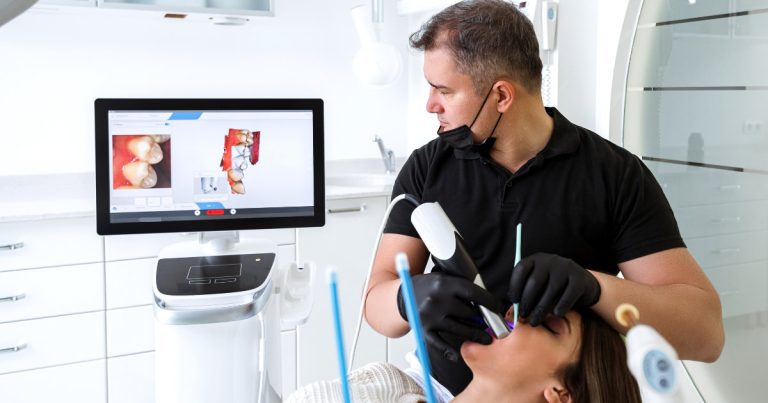
When you go back to the dentist after your gums have healed, they will make impressions of your teeth as well as create a model of your bite. These will be used to create your artificial tooth. You will receive a temporary crown while the permanent crown is being made.

Step 5: Placement of the Dental Crown

Then, when the dentist has the permanent crown ready, you will go back and have your temporary crown removed and replaced with the permanent one.

Step 6: After Surgery

After your surgery, regular dental checkups and proper dental hygiene will ensure your dental implant, and your real teeth, remain functional.

During the surgeries, you will be given options of anesthesia to help ease any pain that may be caused. It’s important to remember the steps listed above are a general outline of a dental implant procedure. Some procedures may be different depending on your needs.


Related Post

Laser Sleep Apnea Treatment

Laser Treatment for Sleep Apnea: A CPAP Alternative?

What Is Laser Treatment for Sleep Apnea? Laser treatment for sleep apnea refers to procedures that use focused laser energy to modify or strengthen soft tissues in the oral airway, aiming to reduce obstruction during sleep. There are two main categories: Laser-Assisted Uvulopalatoplasty (LAUP): A surgical approach where lasers remove or reshape portions of the soft palate and uvula. Non-Ablative Laser Therapy (e.g., NightLase®): A non-surgical, in-office treatment that uses laser energy to heat and tighten oral tissues without cutting.   These options are designed for patients seeking alternatives to Continuous Positive Airway Pressure (CPAP) therapy, especially those with

Read More »
CEREC Same-Day Crown

CEREC Same-Day Crown

Modern dental technology has introduced convenient options like CEREC same-day crowns for restoring damaged teeth. Unlike traditional crowns that require multiple visits and temporary crowns, a CEREC crown is designed, milled, and placed in a single appointment. In this comprehensive guide, we’ll explain what CEREC crowns are, who might need one, how the procedure works, and what to expect before, during, and after treatment. We’ll also cover the benefits, potential drawbacks, alternatives, costs, and address common misconceptions about same-day crowns.   What Are CEREC Same-Day Crowns? A dental crown is a custom-made “cap” that covers a damaged or weakened

Read More »

Related Post

Laser Sleep Apnea Treatment
cem

Laser Treatment for Sleep Apnea: A CPAP Alternative?

What Is Laser Treatment for Sleep Apnea? Laser treatment for sleep apnea refers to procedures that use focused laser energy to modify or strengthen soft tissues in the oral airway, aiming to reduce obstruction during sleep. There are two main categories: Laser-Assisted Uvulopalatoplasty (LAUP): A surgical approach where lasers remove or reshape portions of the soft palate and uvula. Non-Ablative Laser Therapy (e.g., NightLase®): A non-surgical, in-office treatment that uses laser energy to heat and tighten oral tissues without cutting.   These options are designed for patients seeking alternatives to Continuous Positive Airway Pressure (CPAP) therapy, especially those with

Read More »
CEREC Same-Day Crown
cem

CEREC Same-Day Crown

Modern dental technology has introduced convenient options like CEREC same-day crowns for restoring damaged teeth. Unlike traditional crowns that require multiple visits and temporary crowns, a CEREC crown is designed, milled, and placed in a single appointment. In this comprehensive guide, we’ll explain what CEREC crowns are, who might need one, how the procedure works, and what to expect before, during, and after treatment. We’ll also cover the benefits, potential drawbacks, alternatives, costs, and address common misconceptions about same-day crowns.   What Are CEREC Same-Day Crowns? A dental crown is a custom-made “cap” that covers a damaged or weakened

Read More »
Skip to content